Positioning & Audience Strategy
Strong positioning starts with understanding what people value and why they choose. I turn audience and customer research into narratives that help platforms stand out, equip commercial teams, and guide marketing decisions.
Turning community understanding into guidance for brands
The challenge
Brands wanted to understand how to participate on Reddit and respond to criticism. Broad advice about being authentic or relevant left a practical question unanswered: what should a brand actually contribute?
My direction
I translated findings from AI-powered qualitative interviews into a marketing recommendation: start with what a brand can credibly contribute to a particular community. Working with marketing partners, I broadened the emphasis from expertise to utility and relevance, and proposed testing concrete brand responses to make the learning actionable.
What it enabled
The work gave the team a more specific learning agenda for brand participation—one centered on the language, needs, and expectations of communities, with practical examples to inform future guidance.
Related work: Aligning the brand participation story
In a separate workstream, I co-developed a recommendation for how paid, owned, and earned activity fit into Reddit’s brand story. I helped distinguish what brands can do from how communities choose to respond, then narrowed the executive recommendation to the decision that mattered most. The framework gave partners a shared basis for developing talking points and aligning on direction.
Making the case for communities over demographics
The challenge
Entertainment advertisers were accustomed to buying demographic audiences. Twitter needed to explain why its interest-based communities offered a more compelling way to reach viewers.
My direction
I commissioned research into the communities surrounding television shows and their viewing behavior, then helped translate those findings into a narrative for entertainment marketers.
What it enabled
TV Communities & Fandoms gave marketers a clear reason to build audience strategies around shared interests and fan communities, strengthening Twitter’s positioning with television and streaming advertisers.

More about the research
People came to Twitter to talk about what was happening in the world and what mattered to them—and at the top of that list was Television. Although this consumer behavior made Media & Entertainment marketing endemic to Twitter, clients who were used to buying age and gender targets were surprised to learn that Twitter didn’t offer demographic-based targeting for most campaigns.
To help educate and excite entertainment media buyers about how Twitter’s unique platform structure drove tune-in, I commissioned SambaTV and Pulsar to identify the unique communities on Twitter surrounding TV shows and then analyze the tune-in behaviors of those archetypes—some of our key findings: interest-based communities tuned in at rates 4x-5x higher than demographic-based cohorts.
Positioning Twitter as the place to launch a trailer
The challenge
People already came to Twitter to discover and discuss entertainment, but the sales team wanted to capture more of studios’ launch budgets.
My direction
I supervised the design and delivery of a research narrative that positioned Twitter as a premier destination for trailer launches and gave marketers practical guidance for maximizing views in the first 24 hours.
What it enabled
The work connected Twitter’s cultural role with actionable campaign decisions, giving sellers a stronger commercial story and studios a clearer launch strategy.

Deeper analysis
In 2021, my senior stakeholders brought me a challenge: although people already come to Twitter to discover and discuss the newest entertainment properties, the advertising sales team wasn’t capturing its fair share of wallet. How could research better enable the sales team to increase platform spending?
To address this, I supervised the design and delivery of the "Launching a Trailer on Twitter" project, where we positioned Twitter as the premier platform for theatrical marketers and equipped them with a data-backed strategy to maximize trailer views. After we hand-coded data from nearly 100 trailer launch campaigns, our Advanced Analytics team conducted a multi-linear regression analysis to identify which campaign tactics were most associated with maximal trailer views within 24 hours of launch. Some of our findings: there was a 9.8% increase in trailer views for every $100k spent on the total campaign and a 6.3% increase in views when the trailer was released over a year before the movie’s premiere.
Making customer service a platform value proposition
The challenge
Twitter wanted to build on its strengths as a place where people and businesses communicate directly.
My contribution
I contributed research design and narrative development to Beyond Customer Service, connecting brand responses with customers’ future preference and willingness to pay.
What it enabled
The work gave the company a compelling customer-value narrative for its customer-service product priority and appeared in Harvard Business Review.

More about the research
In 2016, newly returned CEO Jack Dorsey wanted the company to double down on its inherent strengths, and one of his top priorities was to help the company position itself as a leader in the customer service space. To that end, I helped my colleagues design a multi-method thought leadership initiative that covered in-person focus groups, social listening, and a conjoin survey. Together, we found that when a customer Tweets at a business and receives a response, they are willing to spend up to 20% more on an average-priced item from that business in the future.
More ways I’ve helped platforms tell their story
TV Tune-In Best Practices
Translating campaign learning into practical creative, targeting, and flighting recommendations.
Project details
At Twitter, I served as a strategic research advisor for senior leaders across sales, marketing, and other functions to maximize and stabilize revenue. When the Entertainment sales team sought to further position itself as an industry leader in driving lower funnel results for TV and streaming advertisers, I supervised the designing and delivering a research narrative that provided its clients with data-driven recommendations on maximizing incremental lift in viewership with Twitter ads. Built on top of two years of campaign measurement, this meta-analysis of viewership conversion studies provided specific recommendations on campaign flighting, creative, and targeting to help marketers—and sellers—maximize success.
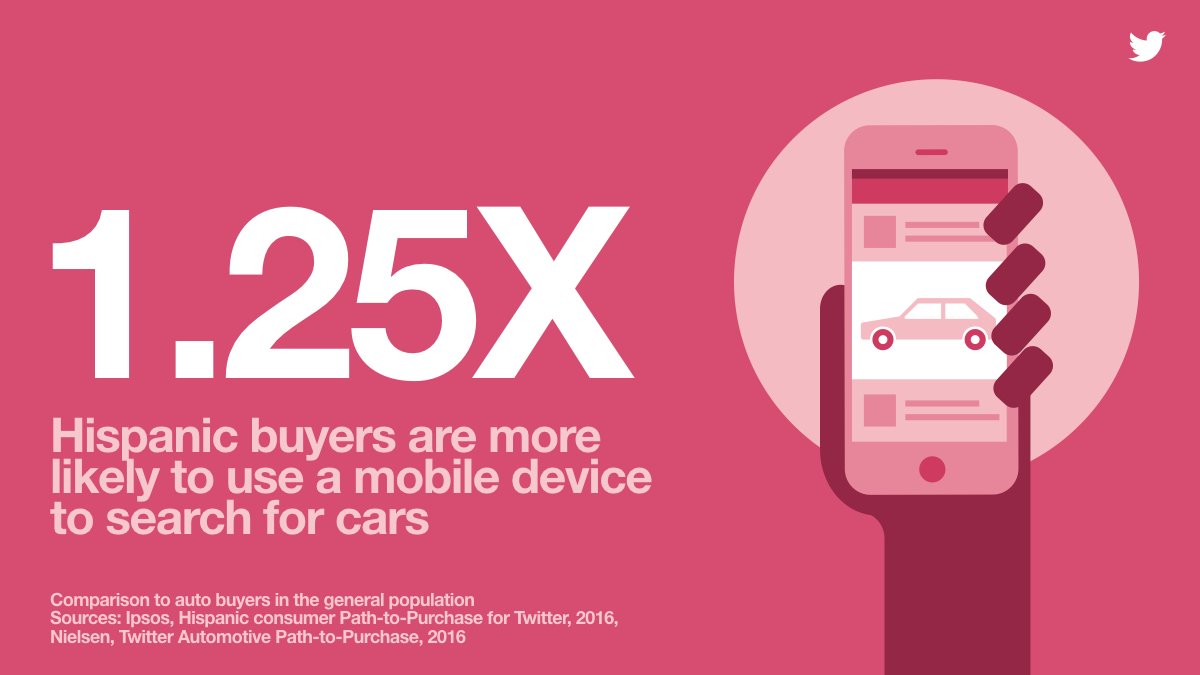
Hispanic Auto Buyers
Building a market narrative around an important automotive audience.
Project details
In the mid twenty-teens, we observed that 49% of US Hispanic auto buyers were reachable via Twitter. To position the platforms as a critical way to reach a valuable audience, I oversaw the design and delivery of “How to connect with the Hispanic auto-buying market on Twitter,” an insights project that aimed to make the case for why multicultural automotive advertisers should have considered Twitter a must-buy. My colleagues and I conducted this research in partnership with Ipsos; participants were adults in the U.S. who identified as Hispanic and had purchased or leased a new vehicle in the past year. We balanced the sample to represent the U.S. Hispanic population by ensuring a distribution of individuals predominantly speaking Spanish, bilingual, and predominantly speaking English.
Why Conversation Matters for Brands
Connecting cultural relevance and conversation with advertiser value.
Project details
One of Twitter’s strategies for staying top-of-mind for media buyers was to lean into the concept of “cultural relevance:” Brands that had a stronger connection to culture were more likely to be preferred and bought. One way of measuring cultural relevance was to count Tweets and see how advertising campaigns on Twitter increased the number of people Tweeting about a given brand or product.
The work demonstrating how the brand conversation on Twitter drove results was a cross-functional effort, but my team contributed a significant portion of the research. In partnership with SambaTV, we found that exposure to paid media and the conversations generated by a Television campaign drove tune-in up to 30x.